Nutrition ingredients routinely cross borders.
Raw materials can be produced in one country, processed in another, formulated elsewhere and ultimately sold across multiple markets.
That global model is well established, but it does not make production location irrelevant.
Where an ingredient is produced can still affect:
- technical capability
- energy supply
- logistics
- regulatory interfaces
- traceability
- customer access
- production resilience
- expansion options
For microalgae-derived ingredients, these considerations become particularly important because production combines biology, engineering, food manufacturing and energy-intensive processing.
New Zealand does not need to replace existing international omega-3 or microalgae production centres to be commercially relevant.
A more practical proposition is to develop an additional production option serving suitable customers in Australia, Asia-Pacific and other international markets.
Ingredient supply chains are global — and concentrated
Omega-3 ingredients, nutraceuticals and specialty nutrition products are already traded globally.
That gives ingredient buyers access to established international suppliers and mature production systems.
However, global sourcing can also create concentration.
A buyer may depend on:
- a small group of manufacturers
- a limited number of production regions
- long freight routes
- common upstream raw materials
- shared processing infrastructure
- the same regulatory or geopolitical environments
The commercial question is therefore not simply whether global supply exists.
It is whether buyers have the right mix of qualified supply options for their particular product and risk profile.
Supply diversification does not require abandoning established suppliers.
It can mean adding another approved source where that makes technical and commercial sense.
Why does production geography still matter?
Two ingredients with similar analytical specifications can still come from very different supply systems.
Location can influence several practical factors.
Customer proximity
Being located closer to a customer does not automatically guarantee faster or cheaper delivery.
Freight routes, shipping frequency, port access, volumes and inventory strategy all matter.
However, regional production can reduce geographical distance for some customers and potentially support closer technical and commercial engagement.
For NuFoods, Australia and selected Asia-Pacific markets are logical areas to investigate because of New Zealand’s existing commercial relationships with the region.
New Zealand Trade and Enterprise reports that South East and East Asia accounted for approximately 18.1% of New Zealand’s total exports of goods and services as at September 2025, with food and beverage and other primary products forming a significant part of the trade relationship.
That does not prove demand for a particular microalgae ingredient, but it demonstrates that New Zealand already operates within established regional trade networks.
Supply diversification
Recent supply-chain disruption has increased attention on resilience across many industries.
For an ingredient buyer, resilience can involve more than holding additional inventory.
It may include:
- qualifying multiple suppliers
- sourcing from different regions
- reducing reliance on a single facility
- understanding upstream raw-material exposure
- maintaining alternative freight routes
- building adequate safety stock
A New Zealand supplier could contribute another geographic option within that wider strategy.
The value would depend on the supplier actually meeting the customer’s specification, quality, pricing and continuity requirements.
Geographic diversity alone is not enough.
Technical and manufacturing capability
Microalgae production requires more than access to land.
Commercial operations can involve:
- biological cultivation
- process control
- water management
- harvesting
- dewatering
- extraction
- drying
- analytical testing
- food-safety systems
- engineering
- automation
- utilities
- maintenance
A credible production location therefore needs access to engineering, food-manufacturing and scientific capability.
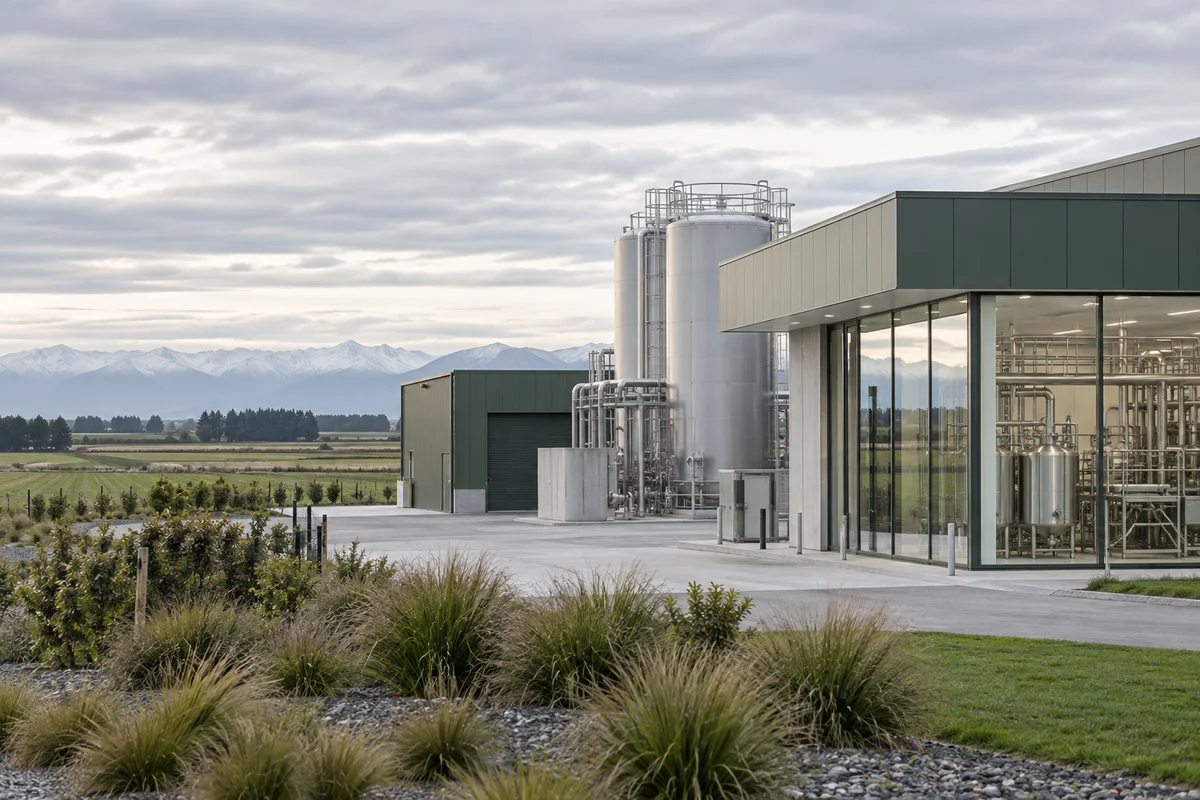
This is one reason Canterbury is relevant to NuFoods’ development programme.
Why Canterbury?
NuFoods is developing its New Zealand programme in Canterbury.
The region has several characteristics relevant to a potential high-value biological manufacturing platform.
Food production and processing
Canterbury has an established connection between primary production and manufacturing.
ChristchurchNZ identifies manufacturing as one of Canterbury’s largest economic sectors and notes the strong relationship between manufacturing and the region’s agricultural base.
Historical regional data also show a significant proportion of Canterbury manufacturing employment is associated with food processing.
This matters because ingredient production depends on many capabilities already familiar to food-manufacturing environments, including:
- hygienic processing
- utilities
- maintenance
- quality control
- logistics
- cold-chain capability where required
- automation
- packaging
- engineering support
Microalgae biotechnology is not identical to conventional food processing, but it can draw on parts of the same industrial ecosystem.
Science and biotechnology capability
Canterbury also has established tertiary and research capability across biological sciences, biotechnology, food science and engineering.
The University of Canterbury describes biotechnology research that brings together biology, chemistry and engineering through its School of Biological Sciences and Biomolecular Interaction Centre.
Lincoln University operates food-innovation programmes covering areas such as food composition, processing, food quality, nutrition, sensory analysis and new-product development.
Those institutions do not constitute proof of NuFoods’ future production performance.
They do, however, demonstrate the presence of scientific and technical capability relevant to a biotechnology and ingredient business.
Engineering capability matters as much as biology
Commercial microalgae production is an engineered biological system.
A strain may perform strongly in the laboratory but still require significant engineering development around:
- light delivery
- heat management
- gas transfer
- pumping
- mixing
- cleaning
- instrumentation
- harvesting
- dewatering
- process integration
Canterbury’s existing manufacturing and engineering base is therefore relevant.
For NuFoods, the attraction is not simply access to scientists.
It is the combination of science, engineering and food-manufacturing capability within the same region.
New Zealand already operates as a food-export economy
Any discussion of New Zealand as an ingredient production base should start with what the country already does at scale.
New Zealand’s economy has a substantial food and fibre export component.
The Ministry for Primary Industries forecast NZ$64.3 billion in food and fibre export revenue for the year to 30 June 2026, following record export revenue in the previous year.
These exports are dominated by established sectors such as dairy, meat and horticulture rather than microalgae.
That distinction matters.
The figures should not be interpreted as evidence that New Zealand already has a large microalgae ingredient industry.
They demonstrate something different: New Zealand has extensive experience producing food products for international markets and operating within export-oriented regulatory and logistics systems.
That is useful infrastructure for emerging high-value ingredient categories to build around.
Asia-Pacific is already an important trading region for New Zealand
New Zealand’s commercial links with Asia-Pacific are not hypothetical.
NZTE identifies food and beverage as a major component of trade with South East and East Asia.
Singapore provides a useful example.
NZTE reported in 2026 that two-way New Zealand–Singapore trade had more than doubled over the preceding decade to approximately NZ$11 billion, with Singapore acting as an important regional hub.
For an emerging ingredient company, established regional trade does not remove the need to build its own:
- distributor relationships
- regulatory approvals
- customer qualifications
- pricing
- logistics
- service model
But it means the company is not attempting to create international trade links from a standing start.

What role does energy play?
Energy is one of the major variables in controlled microalgae production.
Depending on the cultivation and processing system, electricity may be required for:
- pumps
- mixing
- lighting
- heating
- cooling
- harvesting
- dewatering
- drying
- extraction
- utilities
This makes the electricity system of the production location commercially relevant.
New Zealand has a high share of renewable electricity generation.
According to the Ministry of Business, Innovation and Employment, 88.5% of New Zealand’s electricity generation came from renewable sources in 2025, the highest annual share since 1981.
Renewable generation also exceeded 90% across several recent quarters, although the precise mix varies with hydrological and operating conditions.
That creates a potentially useful starting point for electricity-intensive biological production.
It should not be interpreted as meaning any New Zealand-produced ingredient is automatically “low carbon”.
Actual environmental performance depends on:
- total electricity consumption
- time of use
- process heat
- transport
- construction
- raw materials
- downstream processing
- waste treatment
- the specific electricity mix
A proper lifecycle assessment would be required before making product-level carbon claims.
Renewable electricity is not the same as cheap electricity
Another important distinction is cost.
A high renewable share does not automatically make electricity inexpensive.
For energy-intensive biotechnology, commercial viability depends on the actual tariff and demand profile available to the facility.
Relevant questions include:
- electricity price
- peak demand
- network charges
- capacity
- connection costs
- reliability
- future price exposure
- load flexibility
- on-site generation
This is why NuFoods treats energy as a core technical and economic variable rather than simply a sustainability message.
Could on-site renewable generation help?
Potentially.
NuFoods’ longer-term commercial planning is evaluating the integration of on-site solar generation alongside grid electricity.
The intention is not to operate a biological production facility on intermittent solar generation alone.
A commercial cultivation system requires reliable power.
The potential role of solar is therefore to offset part of grid consumption where technical and economic analysis supports it.
Final generation capacity, system configuration and economics remain subject to validation.
Why controlled production can matter regionally
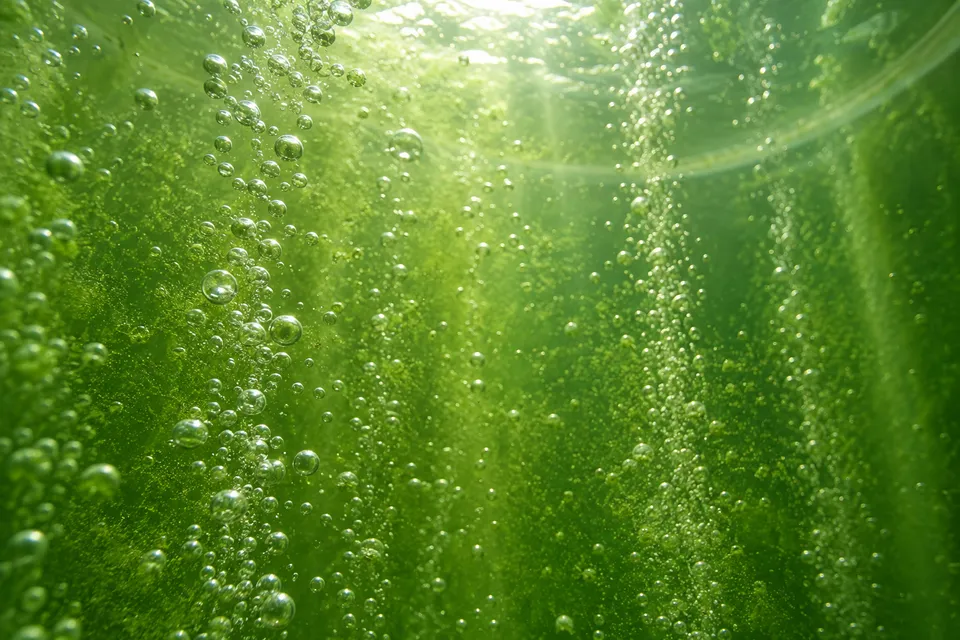
Microalgae can be grown in controlled production systems rather than being harvested directly from marine fish stocks.
That provides a different supply model.
For a regional buyer, potential considerations can include:
- source traceability
- controlled biological inputs
- production scheduling
- batch data
- geographic diversification
- customer-specific product development
These benefits should not be assumed automatically.
A controlled system only creates commercial value if it performs consistently and economically.
That is why NuFoods’ development programme is built around measurement and validation before commercial expansion.
New Zealand is not the closest source to every Asia-Pacific market
It is important not to overstate geography.
Asia-Pacific is a very large region.
A producer in New Zealand will not be geographically closer to every customer than suppliers based in Asia, Europe or North America.
Likewise, freight costs and delivery times will differ by destination.
The case for New Zealand should therefore not be:
“New Zealand is closer to Asia.”
The more defensible proposition is:
“New Zealand can provide an additional Asia-Pacific-oriented production location within an established export economy.”
For some customers, that geography may be commercially attractive.
For others, another source may make more sense.
The customer has to determine that through qualification and procurement.
What buyers should consider when evaluating regional supply
When evaluating a regional ingredient supplier, location should form only one part of the assessment.
Relevant questions include:
Can the supplier meet the specification?
Geography does not compensate for the wrong product.
Is the production system validated?
Buyers need evidence of consistency, quality and process control.
What is the regulatory status?
Requirements vary across Australia, New Zealand and individual Asian markets.
How does logistics actually work?
Evaluate lead times, freight modes, storage, inventory and distribution rather than relying on straight-line distance.
Can production scale with demand?
A regional supplier needs a credible pathway from qualification volumes to commercial supply.
What are the quality and certification systems?
Food safety, documentation, traceability and customer-specific requirements still apply.
Does a second geography improve resilience?
This should be assessed alongside the buyer’s other qualified suppliers and upstream dependencies.
Where NuFoods Biotech fits
NuFoods Biotech is developing a New Zealand-based microalgae ingredient business with an initial focus on EPA-rich algal oil and related high-value microalgae ingredients.
The company’s current programme is staged.
The intention is to validate the biology, cultivation system, downstream processing, product quality, customer requirements and commercial economics before major commercial scale-up.
Canterbury provides the proposed base for that development.
NuFoods is evaluating the region because of its combination of:
- food and agricultural industries
- engineering capability
- scientific and biotechnology capability
- industrial infrastructure
- renewable-heavy electricity system
- established export economy
- access to Australia and wider Asia-Pacific markets
None of these factors by itself establishes a successful microalgae business.
The opportunity comes from combining them with a production system and ingredient that customers actually qualify and purchase.
Building an additional supply option
NuFoods does not need to displace established international suppliers for the New Zealand model to have value.
A more realistic objective is to create another credible source.
That could provide suitable customers with:
- another production geography
- an additional qualified supplier
- EPA-focused product development
- direct technical engagement with a developing producer
- potential regional supply diversification
Whether those benefits justify qualification will ultimately be decided by the customer.
FAQ
Why produce microalgae ingredients in New Zealand?
Potential factors include New Zealand’s food-export capability, scientific and engineering base, renewable-heavy electricity system and existing commercial links with Australia and Asia-Pacific. These advantages still need to translate into competitive product quality, economics and logistics.
Is New Zealand close to Asia-Pacific ingredient customers?
New Zealand is part of the wider Asia-Pacific region and has substantial trade with Asian markets, but it is not geographically closer to every customer than existing production centres. Actual logistics need to be assessed market by market.
Does New Zealand have renewable electricity?
Yes. MBIE reports that 88.5% of New Zealand’s electricity generation came from renewable sources in 2025. The proportion varies over time with generation conditions.
Does renewable electricity make New Zealand-produced ingredients low carbon?
Not automatically. Product-level environmental performance depends on total energy use, transport, processing, raw materials and other lifecycle impacts. A lifecycle assessment is required to substantiate carbon-footprint claims.
Why is Canterbury relevant to biotechnology production?
Canterbury combines agricultural and food-processing activity with engineering, manufacturing and research capability through institutions including the University of Canterbury and Lincoln University.
Could New Zealand replace existing omega-3 supply regions?
That is not the objective. A more realistic role is to develop an additional qualified source for customers who value the product, production location and supply arrangement.
Is NuFoods already producing commercial algae ingredients in New Zealand?
No. NuFoods is developing and validating its proposed production and product platform. Commercial-scale capability remains subject to successful technical, regulatory, customer and economic validation.
References / Further Reading
- New Zealand Ministry of Business, Innovation & Employment. Energy in New Zealand 2026 — Electricity.
Reports that 88.5% of New Zealand electricity generation came from renewable sources in 2025 and provides the official national electricity-generation data.
- New Zealand Ministry for Primary Industries. Situation and Outlook for Primary Industries — June 2026.
Official outlook for New Zealand’s primary-sector production and trade, forecasting food and fibre export revenue of NZ$64.3 billion for the year to 30 June 2026.
- New Zealand Trade and Enterprise. South East and East Asia.
Provides current New Zealand trade data for the region, including the importance of food and beverage exports and the share of total New Zealand exports going to South East and East Asia.
- New Zealand Trade and Enterprise. Exporters help shape future of NZ–Singapore trade relationship. 8 March 2026.
Discusses Singapore’s role as a regional trade hub and approximately NZ$11 billion in two-way New Zealand–Singapore trade.
- University of Canterbury. Biotechnology into the future. 2026.
Overview of current biotechnology research across biology, chemistry and engineering at the University of Canterbury and the Biomolecular Interaction Centre.
- Lincoln University. Master of Science in Food Innovation.
Describes Canterbury-based food-innovation capability spanning food composition, processing, quality, nutrition, safety and sensory evaluation.
- ChristchurchNZ. Christchurch Prosperity Framework.
Regional strategy documenting Canterbury’s manufacturing and engineering base and its connection with food, fibre and agritech activity.